
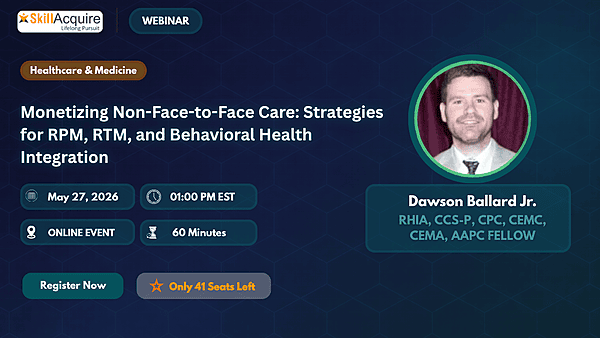
Monetizing Non-Face-to-Face Care: Strategies for RPM, RTM, and Behavioral Health Integration
| Presenter: Dawson Ballard Jr, RHIA, CCS-P, CPC, CEMC Approved Instructor Date: Wednesday, May 27, 2026 Time: 1 pm ET | 12 pm CT | 11 am MT | 10 am PT Duration: 60 minutes |  |
Monetizing non-face-to-face care has become a strategic priority for healthcare organizations as care delivery continues to evolve beyond traditional in-person encounters. Remote Patient Monitoring, Remote Therapeutic Monitoring, and Behavioral Health Integration programs enable providers to deliver continuous, data-driven care while strengthening patient engagement and improving outcomes. These services offer new opportunities to align clinical excellence with financial sustainability by reimbursing time spent monitoring patients, analyzing data, coordinating care, and supporting behavioral health needs outside the exam room.
However, successfully monetizing these services requires more than deploying technology or enrolling patients. Organizations must understand the specific reimbursement pathways, eligibility requirements, and documentation standards that govern non-face-to-face care. RPM and RTM programs rely on clearly defined workflows for device setup, data collection, clinical review, and patient communication, while behavioral health integration services require coordinated collaboration between primary care teams and behavioral health professionals. Without proper alignment, organizations risk underutilizing available codes, missing revenue opportunities, or exposing themselves to compliance and audit risk.
As payers and regulators increase scrutiny of virtual and remote services, documentation integrity has become a critical component of program success. Accurate, timely, and consistent clinical documentation must support the medical necessity of services, the time spent by clinical staff, and the interventions performed. Strong documentation not only ensures appropriate reimbursement but also protects organizations against denials and recoupments in an environment increasingly driven by data analytics and peer benchmarking.
Equally important is the operational integration of non-face-to-face care into existing clinical and revenue cycle processes. Effective programs break down silos between clinical teams, care management, compliance, and billing to create standardized workflows that support scalability and sustainability. Training staff, setting clear expectations, and leveraging reporting tools all play a role in maintaining program performance while supporting high-quality patient care.
Ultimately, monetizing non-face-to-face care is not simply about adding new services, but about rethinking how care is delivered, documented, and reimbursed across the continuum. When RPM, RTM, and behavioral health integration are implemented with a strategic, compliant, and patient-centered approach, organizations can extend their reach, enhance care coordination, and generate meaningful revenue that supports long-term growth. This topic explores the strategies, risks, and best practices necessary to build successful non-face-to-face care programs that deliver value for both patients and providers.
For healthcare leaders, revenue cycle professionals, and clinical teams, understanding these models is increasingly essential as fee-for-service and value-based reimbursement continue to converge. Non-face-to-face care supports preventive interventions, earlier clinical insights, and more proactive management of chronic and behavioral health conditions. When thoughtfully designed, these programs reduce avoidable utilization, strengthen patient trust, and create predictable revenue streams. By staying informed about evolving coverage rules, operational best practices, and documentation expectations, organizations can confidently invest in remote and integrated care models that meet patient needs today while positioning themselves for tomorrow’s healthcare landscape. This comprehensive focus equips stakeholders with the clarity needed to translate innovation into measurable, compliant, and sustainable results across diverse care settings. Ultimately these insights support smarter decisions better outcomes stronger organizations and long term financial resilience nationwide.
- Identify reimbursement opportunities for non-face-to-face care services, including Remote Patient Monitoring (RPM), Remote Therapeutic Monitoring (RTM), and Behavioral Health Integration, and understand how these services fit into current payment models.
- Understand documentation and compliance requirements necessary to support medical necessity, time-based billing, and audit defensibility for non-face-to-face care services.
- Recognize common operational and documentation pitfalls that can lead to missed revenue, denials, or increased audit risk when implementing or expanding remote and integrated care programs.
- Apply practical strategies to integrate RPM, RTM, and behavioral health services into existing clinical, care management, and revenue cycle workflows to support sustainable, compliant program growth.
- Reimbursement Pathways for Non Face to Face Care
An overview of how Remote Patient Monitoring (RPM), Remote Therapeutic Monitoring (RTM), and Behavioral Health Integration services are reimbursed, including key coverage considerations, qualifying activities, and how these services fit into evolving payment models. - Documentation and Compliance Requirements
A focused review of documentation expectations that support medical necessity, time-based billing, and service delivery for non-face-to-face care. This area highlights common documentation gaps, audit risk considerations, and the importance of aligning clinical notes with billed services. - Operational and Workflow Integration Strategies
Practical insight into integrating RPM, RTM, and behavioral health services into existing clinical, care management, and revenue cycle workflows. Attendees will learn how cross-functional alignment supports scalability, compliance, and sustainable revenue generation. - Live Q&A Session
- Understand How to Maximize Reimbursement for Non-Face-to-Face Services
Gain clarity on how RPM, RTM, and Behavioral Health Integration programs can generate sustainable revenue when structured and documented correctly. Attendees will learn where reimbursement opportunities exist today and how to align clinical workflows with billing requirements to fully capture earned revenue. - Reduce Risk While Expanding Virtual and Remote Care Programs
As regulatory oversight and payer scrutiny increase, it is critical to understand the documentation and compliance expectations tied to non-face-to-face services. This session highlights common pitfalls and risk areas so organizations can confidently scale remote monitoring and behavioral health services without exposing themselves to audits, denials, or recoupments. - Create an Operational Roadmap for Sustainable Program Growth
Learn how to connect clinical, operational, and revenue cycle teams around a shared strategy for non-face-to-face care. Attendees will leave with practical insights on integrating RPM, RTM, and behavioral health services into existing care models in a way that supports patient outcomes while strengthening long-term financial performance.
- Coders
- Administrators
- CDI Professionals
- Billers
- Physicians
- Physician Advisors
- Nurse Practitioners
- Physician Assistants
- Behavioral Health Specialists
- Care Managers
- Revenue Cycle Professionals
- Case Managers
- Utilization Review Specialists
- Compliance Officers
- Revenue Integrity and Audit Professionals
- Health Information Management (HIM) Professionals
- Population Health Leaders
- Quality Improvement Teams
You will receive an email with login information and handouts (presentation slides) that you can print and share with all participants at your location.
- Internet Speed: Preferably above 1 MBPS
- Headset: Any decent headset and microphone which can be used to talk and hear clearly
No problem. You can get access to an On-Demand webinar. Use it as a training tool at your convenience.
Toll-Free No: 1-302-444-0162
Email: care@skillacquire.com
Address: 651 N. Broad Street, Suite 206, Middletown, DE 19709


