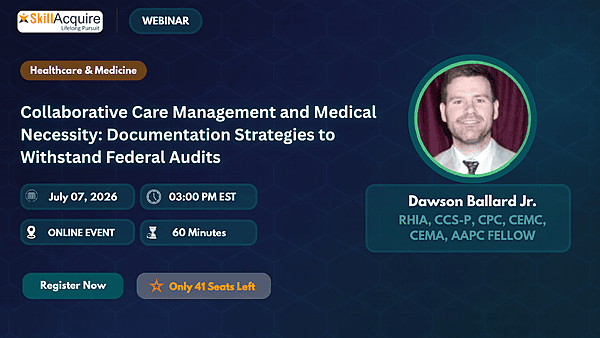
Collaborative Care Management and Medical Necessity: Documentation Strategies to Withstand Federal Audits
| Presenter: Dawson Ballard Jr, RHIA, CCS-P, CPC, CEMC Approved Instructor Date: Tuesday, July 07, 2026 Time: 3 pm ET | 2 pm CT | 1 pm MT | 12 pm PT Duration: 60 minutes |  |
Collaborative Care Management (CoCM) has emerged as a critical care model for integrating behavioral health services into primary and specialty medical settings, particularly for patients with chronic medical and mental health conditions. Designed to promote team based, patient centered care, CoCM relies on coordinated efforts among physicians, behavioral health specialists, care managers, and other clinical professionals. As healthcare systems expand adoption of this model to improve outcomes and access to care, accurate documentation becomes essential to demonstrate the clinical value, medical necessity, and compliance of these services.
In parallel with increased utilization, regulatory oversight of Collaborative Care Management has intensified. The Centers for Medicare and Medicaid Services and their audit contractors have placed heightened scrutiny on services that involve time based billing, interdisciplinary communication, and non traditional care workflows. CoCM services frequently depend on cumulative monthly time, indirect patient interactions, and shared clinical responsibility, all of which can create documentation challenges if expectations are not clearly understood or consistently applied across care teams.
Audit findings have shown that vulnerabilities often stem not from intentional misuse, but from documentation gaps that fail to clearly connect patient complexity, treatment planning, and billed services. Common risk areas include inconsistent clinical narratives, insufficient support for medical necessity, unclear linkage between patient needs and care manager activities, and misalignment between physician documentation and coding practices. When records do not clearly tell the patient’s story or reflect the intensity of services provided, organizations face increased risk of denials, payment recoupments, and compliance exposure.
Compounding these challenges is the need for cross functional alignment among physicians, coders, clinical documentation integrity professionals, utilization review teams, and compliance leadership. Each group plays a distinct role in supporting Collaborative Care Management, yet miscommunication or siloed workflows can undermine the defensibility of services. Without shared understanding of documentation standards and audit expectations, even well designed CoCM programs may struggle to withstand external review.
As healthcare organizations continue to invest in collaborative care models, strengthening documentation practices is no longer optional. Clear, consistent, and clinically meaningful documentation is essential not only for regulatory compliance, but also for sustaining reimbursement, supporting quality reporting, and demonstrating the value of integrated care. By proactively addressing documentation integrity and aligning stakeholders around medical necessity standards, organizations can reduce audit risk, protect revenue, and ensure the long term success of Collaborative Care Management programs.
This background underscores why education, standardization, and shared accountability are essential as organizations mature their Collaborative Care Management strategies. Training that clarifies regulatory intent, documentation expectations, and audit risk helps clinical and revenue teams move from reactive correction to proactive compliance. When documentation accurately reflects patient acuity, clinical decision making, and coordinated interventions, it supports defensible billing and reinforces trust in the collaborative care model. Ultimately, a disciplined documentation approach enables healthcare systems to balance innovation with compliance, expand access to behavioral health services, and deliver integrated care that meets both patient needs and regulatory requirements across diverse care settings, payment models, and evolving federal oversight frameworks nationwide today for sustainability and resilience long term success goals achieved consistently everywhere effectively.
- Identify key documentation and medical necessity gaps that place Collaborative Care Management services at increased risk for federal audits, denials, and payment recoupments.
- Explain how CMS and audit contractors evaluate Collaborative Care Management records, including common audit triggers related to time based billing, interdisciplinary care, and documentation consistency.
- Apply best practice documentation strategies to strengthen clinical narratives, support patient complexity, and align billed services with medical necessity requirements.
- Assess opportunities for improved cross functional alignment among physicians, coders, CDI, utilization review, and compliance teams to enhance audit readiness and protect reimbursement.
- Audit Risk Drivers in Collaborative Care Management
- Examination of how CMS and audit contractors assess Collaborative Care Management services, including common documentation weaknesses, audit triggers, and patterns that lead to denials and payment recoupments.
- Documentation and Medical Necessity Best Practices
- Review of documentation standards needed to support medical necessity, patient complexity, and time based CoCM services, with focus on strengthening clinical narratives and aligning documentation with billed services.
- Cross Functional Alignment for Audit Ready CoCM Programs
- Strategies to improve collaboration among physicians, coders, CDI, utilization review, and compliance teams to ensure consistent documentation, reduce audit exposure, and protect reimbursement.
- Live Q&A Session
- Understand Where Audit Risk Truly Begins
- Gain clarity on how documentation gaps—not just coding errors—drive federal audit selection, denials, and recoupments. This session explains how CMS and its contractors evaluate medical records and identify risk patterns, helping attendees recognize vulnerabilities before an audit occurs
- Learn Practical Strategies to Strengthen Documentation and Medical Necessity
- Explore real‑world documentation challenges that commonly undermine Collaborative Care Management services, including inconsistent narratives, weak clinical rationale, and misalignment across care teams. Attendees will learn actionable approaches to improve documentation integrity and better support medical necessity and compliant billing.
- Improve Cross‑Functional Alignment to Protect Revenue
- Discover how stronger collaboration between physicians, coders, CDI,utilization review, and compliance teams can reduce audit exposure and improve defensibility. This session equips attendees with insight to align workflows, reduce denials, and support sustainable, audit‑ready Collaborative Care Management programs.
- Coders
- Administrators
- CDI Professionals
- Billers
- Physicians
- Physician Advisors
- Nurse Practitioners
- Physician Assistants
- Behavioral Health Specialists
- Care Managers
- Revenue Cycle Professionals
- Case Managers
- Utilization Review Specialists
- Compliance Officers
- Revenue Integrity and Audit Professionals
- Health Information Management (HIM) Professionals
- Population Health Leaders
- Quality Improvement Teams
You will receive an email with login information and handouts (presentation slides) that you can print and share with all participants at your location.
- Internet Speed: Preferably above 1 MBPS
- Headset: Any decent headset and microphone which can be used to talk and hear clearly
No problem. You can get access to an On-Demand webinar. Use it as a training tool at your convenience.
Toll-Free No: 1-302-444-0162
Email: care@skillacquire.com
Address: 651 N. Broad Street, Suite 206, Middletown, DE 19709


