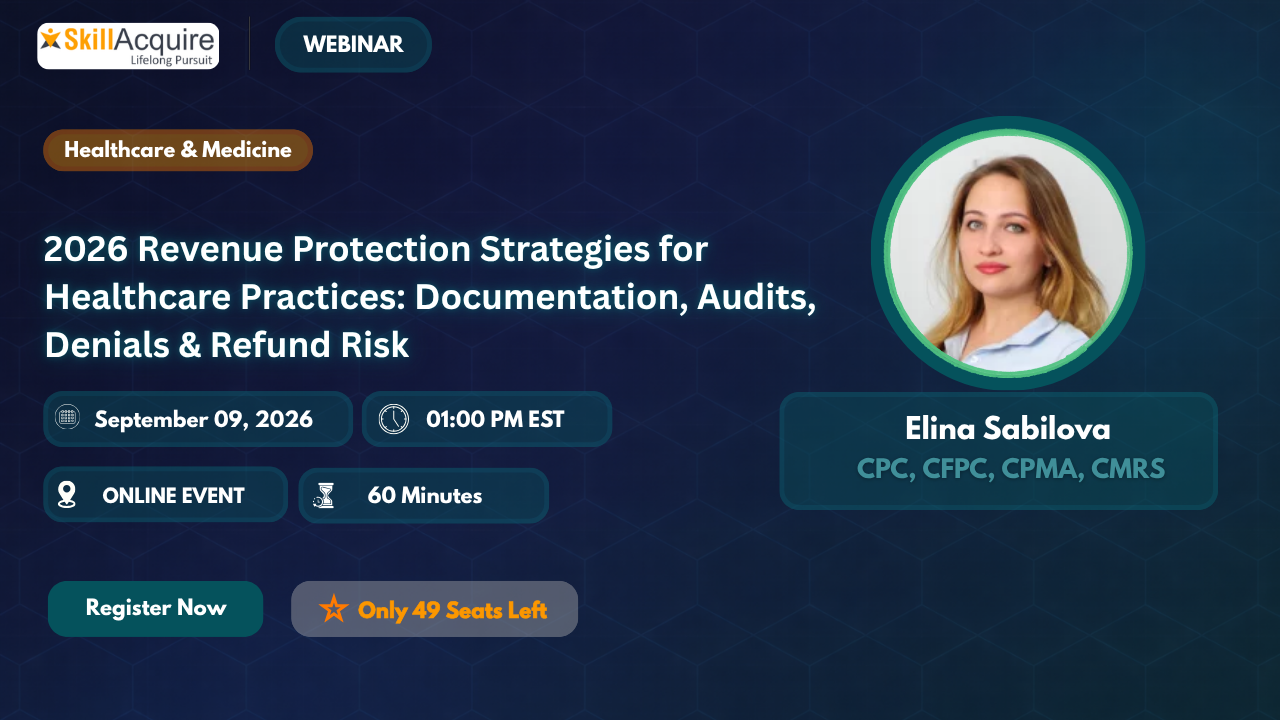
2026 Revenue Protection Strategies for Healthcare Practices: Documentation, Audits, Denials & Refund Risk
| Presenter: Elina Sabilova, CPC, CFPC, CPMA, CMRS Date: Wednesday, September 09, 2026 Time: 1 pm ET | 12 pm CT | 11 am MT | 10 am PT Duration: 60 minutes |  |
Healthcare practices are under constant pressure to improve collections, reduce denials, and stay compliant with payer, Medicare, Medicaid, and commercial insurance requirements. In 2026, protecting revenue requires more than simply submitting claims quickly. Practices must be able to prove that every service billed was medically necessary, properly documented, correctly coded, and supported by a complete audit trail.
This session will focus on practical revenue protection strategies that connect documentation compliance, coding accuracy, denial prevention, audit readiness, and refund/overpayment controls. Attendees will learn how weak documentation, unsupported modifiers, missed orders, incomplete medical necessity support, authorization failures, and poor denial tracking can lead to payment delays, takebacks, payer audits, and refund obligations.
The session will also explain why a paid claim is not always a compliant claim and how practices can strengthen internal review processes before issues become costly. Special attention will be given to building documentation standards, preparing for audit requests, using denial data as a compliance warning system, and creating reliable workflows for credit balances, retroactive refund issues, and self-identified overpayments.
The goal is to help practices move from reactive billing cleanup to proactive revenue protection, ensuring that revenue is not only collected, but also fully defensible.
- Identify the most common documentation gaps that create denial, audit, and refund risks.
- Explain why medical necessity must be clearly supported in the provider record, not only on the claim form.
- Recognize how coding, modifier usage, orders, authorizations, and diagnosis selection affect revenue protection.
- Build an audit-ready claim file that supports both the service billed and the payment received.
- Use denial trends to uncover workflow issues across registration, authorization, coding, billing, and provider documentation.
- Distinguish between front-end revenue leakage, claim denial risk, and post-payment audit exposure.
- Develop a practical internal audit plan for high-risk services, providers, payers, and modifiers.
- Create a compliant workflow for identifying, reviewing, approving, reporting, and returning overpayments or credit balances.
- Understand how timely appeal handling and documentation retrieval can reduce preventable write-offs.
- Apply revenue protection metrics to monitor risk and improve practice performance throughout 2026.
- The difference between revenue collection and revenue protection.
- Key 2026 risk areas affecting physician practices and outpatient healthcare organizations.
- Documentation standards that support medical necessity and payer coverage requirements.
- Common documentation failures that lead to denials, recoupments, and refund exposure.
- Modifier documentation risks, including Modifier 25, 59/X modifiers, TC/PC, repeat services, and bilateral services.
- Order, referral, authorization, and eligibility controls that help prevent front-end claim failures.
- How to prepare a complete audit response packet for payer, Medicare, Medicaid, or commercial audits.
- Responding to documentation requests, ADRs, payer audits, and post-payment reviews.
- Using denial data as a compliance and operational warning system.
- Appeal workflows, deadline tracking, and strategies to prevent avoidable write-offs.
- Credit balances, retroactive refund issues, overpayment identification, and internal approval workflows.
- Building a 2026 internal audit schedule based on risk, denial data, and payer behavior.
- Revenue protection dashboard metrics for leadership, billing teams, coders, and compliance staff.
- Interactive Q&A session after the webinar and receive direct answers from our expert speaker..
- Practice administrators
- Billing managers and supervisors
- Certified professional coders
- Medical billers
- Revenue cycle managers
- Compliance officers and compliance staff
- Auditors and internal audit teams
- Office managers
- Provider relations and credentialing staff
- Front-desk and registration supervisors
- Authorization and referral coordinators
- Denial management specialists
- Appeals specialists
- Physician practice owners and executives
- Healthcare consultants and operations leaders
- Healthcare finance directors and reimbursement analysts
- Clinical documentation improvement (CDI) specialists
- Physician assistants (PAs) and nurse practitioners (NPs) involved in documentation workflows
- Risk management and quality assurance professionals
- Hospital and outpatient clinic administrators
Elina Sabilova, CPC, CFPC, CPMA, CMRS
Elina is a billing department supervisor with 12 years of experience in healthcare billing, coding, and auditing. Her professional background includes revenue cycle operations, denial prevention, payer follow-up, documentation review, coding support, and staff education.
She focuses on practical, workflow-based strategies that help billing teams identify claim risks early, reduce avoidable denials, and improve communication among front-office staff, coders, billers, providers, and management.
Her teaching style emphasizes real-world examples, compliance awareness, payer-specific problem-solving, and actionable tools that healthcare organizations can apply immediately to daily revenue cycle operations
You will receive an email with login information and handouts (presentation slides) that you can print and share with all participants at your location.
- Internet Speed: Preferably above 1 Mbps
- Headset: Any decent headset and microphone which can be used to talk and hear clearly
No problem. You can get access to an On-Demand webinar. Use it as a training tool at your convenience.
Toll-Free No: 1-302-444-0162
Email: care@skillacquire.com
Address: 651 N. Broad Street, Suite 206, Middletown, DE 19709