
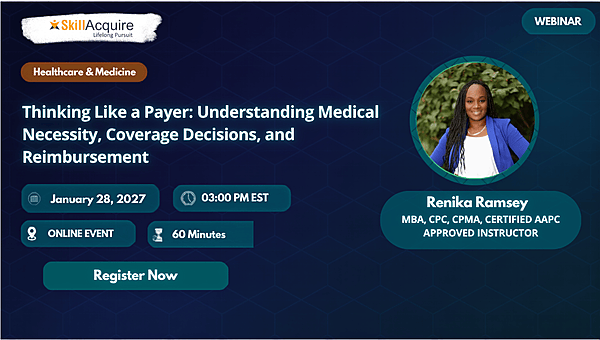
Thinking Like a Payer: Understanding Medical Necessity, Coverage Decisions, and Reimbursement
Presenter: Renika Ramsey, MBA, CPC, CPMA, Certified AAPC Approved Instructor Date: Thursday, January 28, 2027 Time: 3 pm ET | 2 pm CT | 1 pm MT | 12 pm PT Duration: 60 minutes |  |
Course Description
Healthcare coverage decisions involve more than determining whether a service or treatment is clinically appropriate. Behind every coverage determination are considerations involving clinical evidence, medical necessity, established coverage criteria, benefit provisions, and applicable program or payer requirements. Yet many healthcare professionals interact with these decisions without fully understanding the reasoning and processes that influence them.
This webinar takes participants beyond the claim and introduces the payer perspective on healthcare coverage and reimbursement. Participants will explore how clinical evidence informs coverage standards, how medical necessity is evaluated, and how coverage policies and program requirements influence decisions about healthcare services and treatment options.
The session will examine the distinction between clinical appropriateness and coverage eligibility, highlighting why a treatment may be supported by a provider’s clinical judgment but still require additional evaluation under an applicable coverage policy. Participants will also explore the role of clinical documentation in supporting coverage determinations and understand how coding accuracy, documentation sufficiency, authorization requirements, and reimbursement policies intersect.
Through practical examples and a case-based discussion, attendees will learn to approach coverage questions with a broader understanding of the factors that influence payer decisions. Rather than focusing solely on identifying denials or correcting claim errors, the session encourages healthcare professionals to understand the underlying logic behind coverage requirements and how those requirements affect different areas of healthcare operations.
Drawing on experience in federal healthcare programs, including research into treatment appropriateness, evaluation of coverage considerations, and the development of program benchmarks and standards, Renika Ramsey will share insights into the decision-making considerations that shape healthcare coverage.
Whether working in medical coding, billing, auditing, clinical operations, compliance, or healthcare administration, participants will gain a stronger foundation for understanding the relationship between clinical evidence, medical necessity, coverage decisions, and reimbursement.
Learning Objectives
- Explain the role of payers in establishing and administering healthcare coverage requirements.
- Differentiate clinical appropriateness, medical necessity, and coverage eligibility.
- Identify key clinical, administrative, and program considerations that influence coverage determinations.
- Describe how clinical research and evidence-based standards contribute to the development of coverage policies.
- Explain the importance of benchmarks, clinical criteria, and established standards in supporting consistent coverage decisions.
- Identify documentation elements that help demonstrate whether applicable medical necessity and coverage criteria are satisfied.
- Describe the relationship between coding accuracy, coverage policies, authorization requirements, and reimbursement.
- Analyze common disconnects between provider expectations and payer coverage requirements.
- Apply a payer-oriented decision-making framework to practical healthcare coverage scenarios.
- Recognize opportunities to improve communication and alignment between clinical, coding, billing, and administrative teams.
Areas Covered in the Session
- Understanding the Payer Perspective
- The role of commercial insurers
- Medicare
- Medicaid
- Other healthcare programs in coverage and reimbursement
- The role of commercial insurers
- The Fundamentals of Medical Necessity
- Understanding medical necessity
- Its relationship to clinical judgment and reimbursement
- Understanding medical necessity
- Clinical Appropriateness vs. Coverage Eligibility
- Why a clinically appropriate service is not automatically a covered service
- Why a clinically appropriate service is not automatically a covered service
- Factors Influencing Coverage Decisions
- Clinical circumstances
- Treatment evidence
- Eligibility
- Benefit provisions
- Applicable coverage criteria
- Clinical circumstances
- From Clinical Evidence to Coverage Policies
- How research
- Clinical guidelines
- Established standards inform coverage requirements
- How research
- The Role of Benchmarks and Standards
- Understanding how benchmarks support consistent evaluations and coverage determinations
- Understanding how benchmarks support consistent evaluations and coverage determinations
- The Coverage Decision-Making Process
- Examining the considerations involved in evaluating requested healthcare services and treatments
- Examining the considerations involved in evaluating requested healthcare services and treatments
- Documentation Through the Payer’s Lens
- Identifying the clinical information needed to support coverage and medical necessity requirements
- Identifying the clinical information needed to support coverage and medical necessity requirements
- Common Provider-Payer Disconnects
- Exploring gaps between clinical expectations
- Documentation practices
- Payer requirements
- Exploring gaps between clinical expectations
- Where Medical Coding Fits
- Understanding how diagnosis and procedure codes communicate information and interact with coverage policies
- Understanding how diagnosis and procedure codes communicate information and interact with coverage policies
- From Coverage Determination to Reimbursement
- Exploring the relationship between coverage approval
- Claim submission
- Payment requirements
- Exploring the relationship between coverage approval
- Practical Case Study and Scenario Analysis
- Applying payer-oriented thinking to real-world-inspired coverage situations
- Applying payer-oriented thinking to real-world-inspired coverage situations
- Strategies for Better Alignment
- Identifying opportunities to improve communication
- Documentation
- Understanding of payer requirements
- Identifying opportunities to improve communication
- Interactive Q&A Session with Renika Ramsey, MBA, CPC, CPMA, Certified AAPC Approved Instructor
Recommended Participants
- Medical Coders
- Medical Auditors
- Medical Billers
- Revenue Cycle Professionals
- Physicians and Other Healthcare Providers
- Physician Assistants and Nurse Practitioners
- Clinical Documentation Improvement (CDI) Specialists
- Utilization Management Professionals
- Healthcare Compliance Officers
- Healthcare Administrators and Practice Managers
- Claims Analysts and Claims Reviewers
- Healthcare Consultants
- Healthcare Quality Improvement Professionals
- Healthcare Program and Policy Professionals
About the Presenter
Renika Ramsey, MBA, CPC, CPMA, Certified AAPC Approved Instructor, is a healthcare professional with extensive experience in medical coding, auditing, healthcare operations, federal healthcare programs, and project management. She is a Certified Professional Coder, Certified Professional Medical Auditor, and AAPC-certified instructor.
Her professional background includes more than a decade of experience across healthcare and government environments, including federal healthcare program operations, where she has supported research, program oversight, coverage-related evaluations, and the development of standards and benchmarks. Her experience includes evaluating the appropriateness of treatment options, researching healthcare program requirements, and providing recommendations to support program decision-making.
Renika also brings experience in healthcare project management, contract oversight, operational analysis, and cross-functional collaboration. She holds a Master of Business Administration (MBA) and a graduate certificate in Healthcare Analytics, which complement her background in healthcare administration, data analysis, and process improvement.
Through her company, Health Admin Solutions, LLC, Renika focuses on helping healthcare organizations strengthen operational performance through coding education, auditing, revenue cycle analysis, compliance support, and customized educational solutions.
Her approach to healthcare education emphasizes understanding the reasoning behind healthcare policies, reimbursement requirements, and operational decisions. She is passionate about helping healthcare professionals move beyond task-based responsibilities to develop the analytical skills and broader industry perspective needed to contribute to organizational performance.
Additional Information
After Registration:
After registering, you'll receive a confirmation email with your unique login details and access to presentation materials. All documents are downloadable and ideal for team training or reference.
System Requirements:
- Internet Speed: Preferably above 1 Mbps
- Headset: Any decent headset and microphone that can be used to talk and hear clearly
Can't Listen Live?
No problem. You can get access to an On-Demand webinar. Use it as a training tool at your convenience.
For more information, you can reach out to the contact below:
Toll-Free No: 1-302-444-0162
Email:training@skillacquire.com
Address: 651 N. Broad Street, Suite 206, Middletown, DE 19709