
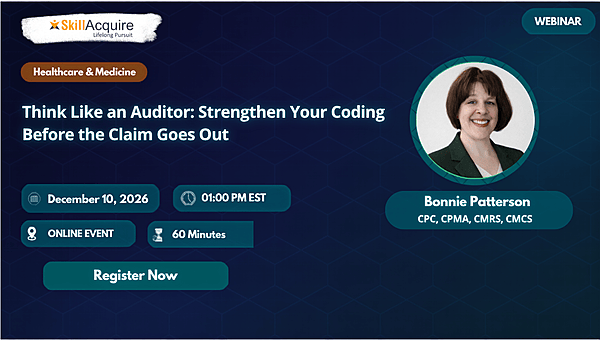
Think Like an Auditor: Strengthen Your Coding Before the Claim Goes Out
Presenter: Bonnie Patterson, CPC, CPMA, CMRS, CMCS Date: Thursday, December 10, 2026 Time: 1 pm ET | 12 pm CT | 11 am MT | 10 am PT Duration: 60 minutes |  |
Course Description
Every coded claim tells a story, and when a payer or auditor requests the medical record, the documentation must support every detail of what was billed. CMS FY 2025 improper payment findings continue to highlight insufficient documentation as a significant source of payment errors. In Medicare Advantage, unsupported diagnoses remain an important area of concern. These findings reinforce why accurate coding must go beyond selecting the right code—it requires verifying that the medical record fully supports the services, diagnoses, and reporting choices on the claim.
This practical, case-driven webinar will help coders, billers, and auditors develop an auditor’s mindset and identify documentation and coding risks before claims are submitted. Participants will learn how to apply a five-question pre-bill review framework—Who, What, Why, How Much, and Which Rules—to evaluate outpatient claims more effectively. The session will cover essential review techniques for E/M level selection using medical decision making or total practitioner time, ICD-10-CM diagnosis accuracy and specificity, modifier usage, National Correct Coding Initiative (NCCI) edits, medically unlikely edits (MUEs), and applicable coverage requirements.
Attendees will also explore documentation weaknesses and billing patterns that can attract payer or government scrutiny, including cloned notes, unsupported chronic conditions, modifier misuse, and unusual E/M distribution patterns. Through five realistic case scenarios, participants will practice identifying potential errors and determining when a correction, additional documentation, or a compliant provider query may be necessary.
The session will further explain the financial and compliance implications of errors discovered after payment, including potential overpayment obligations, extrapolation, and the 60-day repayment requirement. Participants will leave with a practical pre-bill review checklist, a repeatable self-audit approach, guidance for writing compliant and non-leading provider queries, and authoritative reference resources they can use in their daily coding and auditing work.
Learning Outcomes
- Explain how an auditor's review differs from a production-focused coding review and why documentation errors drive most improper payments.
- Apply a five-question pre-bill checklist (Who, What, Why, How Much, Which Rules) to outpatient claims.
- Validate E/M levels using medical decision making or total practitioner time under current guidelines.
- Apply ICD-10-CM outpatient guidelines for specificity, sequencing, uncertain diagnoses, and chronic conditions.
- Determine whether documentation supports commonly scrutinized modifiers, including 25, 59/X, 22, 76/77, and 91.
- Use NCCI PTP edits, MUEs, LCDs/NCDs, and ABN requirements to prevent avoidable denials.
- Recognize red flags that trigger payer and government reviews, including cloned documentation and skewed E/M patterns.
- Build a repeatable self-audit cycle and write compliant, non-leading provider queries.
Areas Covered in the Session
- CMS Improper Payment Findings and Why Documentation Matters
- Key takeaways from FY 2025 CMS improper payment findings.
- How insufficient documentation contributes to payment errors.
- Key takeaways from FY 2025 CMS improper payment findings.
- Pre-Bill Versus Post-Payment Risk
- Correcting errors before claim submission versus addressing them after payment.
- Overpayment recovery, extrapolation, and the 60-day repayment requirement.
- Why early identification can reduce compliance and financial exposure.
- Correcting errors before claim submission versus addressing them after payment.
- Developing the Auditor's Mindset
- Production-focused coding versus audit-focused review.
- Three fundamental principles behind an effective audit.
- Production-focused coding versus audit-focused review.
- The Five-Question Pre-Bill Review Framework
- Who: Is the provider and patient information properly supported?
- What: Are the services and diagnoses accurately reported?
- Why: Does the documentation establish medical necessity?
- How Much: Are the codes, units, and levels supported?
- Which Rules: Have applicable coding and coverage requirements been followed?
- Who: Is the provider and patient information properly supported?
- E/M Code Selection and Validation
- Medical decision making: problems, data, and risk.
- Total practitioner time and appropriate time-based code selection.
- Medical decision making: problems, data, and risk.
- ICD-10-CM Diagnosis Coding Accuracy
- Specificity, sequencing, and required code details.
- Outpatient uncertain diagnoses and chronic condition reporting.
- Following instructional notes and applicable coding guidelines.
- Specificity, sequencing, and required code details.
- Modifier Documentation and Appropriate Use
- Modifier 25: Significant, separately identifiable E/M services.
- Modifier 59 and X{EPSU}: Distinct procedural services.
- Modifiers 22, 24, 57, 76, 77, and 91: Documentation and reporting considerations.
- Identifying unsupported or excessive modifier use.
- Modifier 25: Significant, separately identifiable E/M services.
- NCCI Edits and Coverage Requirements
- NCCI PTP edits and modifier exceptions.
- MUEs, LCDs, NCDs, and ABN requirements.
- NCCI PTP edits and modifier exceptions.
- Medical Record Documentation Integrity
- Provider signatures, dates, and authentication.
- Orders, late entries, and amendments.
- Identifying cloned, copied-forward, or inconsistent documentation.
- Provider signatures, dates, and authentication.
- Red Flags That Can Attract Audit Attention
- Unusual E/M distribution patterns compared with peers.
- Unsupported chronic diagnoses, modifier overuse, and other documentation concerns.
- Unusual E/M distribution patterns compared with peers.
- Practical Case Scenarios and Application
- Identifying potential E/M overcoding.
- Reviewing modifier 25 with a minor procedure.
- Handling outpatient "rule out" diagnoses.
- Recognizing unsupported chronic conditions.
- Correcting time-based E/M leveling errors.
- Identifying potential E/M overcoding.
- Building a Sustainable Self-Audit Process
- Establishing a repeatable pre-bill and self-audit cycle.
- Writing compliant, non-leading provider queries.
- Interactive knowledge check and authoritative coding reference resources.
- Establishing a repeatable pre-bill and self-audit cycle.
- Interactive Q&A session with Bonnie Patterson, CPC, CPMA, CMRS, CMCS
Similar Webinars You May Like
Recommended Participants
- Medical Coders (CPC, CCS-P, COC)
- Coding Auditors and Compliance Auditors (CPMA)
- Medical Billers and Billing Specialists
- Revenue Integrity and Revenue Cycle Analysts
- Compliance Officers and Compliance Staff
- Clinical Documentation Improvement (CDI) Specialists
- Denial Management and Accounts Receivable Staff
- Practice Managers and Practice Administrators
- Physicians, Nurse Practitioners, and Physician Assistants
- Health Information Management (HIM) Professionals
- Coding Educators and Trainers
- Medical Billing and Coding Managers
- Healthcare Internal Auditors
- Medicare and Medicare Advantage Compliance Specialists
- Physician Documentation Improvement Specialists
- Reimbursement and Payment Integrity Specialists
- Healthcare Quality Assurance Professionals
- Independent Coding Consultants and Audit Consultants
- Outpatient Facility and Ambulatory Surgery Center (ASC) Coding Professionals
- Healthcare Consultants and Revenue Cycle Managers
About the Presenter
Bonnie Patterson, CPC, CPMA, CMRS, CMCS, is a medical coding auditor, compliance strategist, speaker, and educator who specializes in coding accuracy, compliance auditing, revenue integrity, and fraud, waste, and abuse (FWA) analysis. Her work is built on a simple principle: every coded claim tells a story, and that story should be one the medical record can prove.
Bonnie brings more than four years of experience in multispecialty outpatient and ancillary settings, with coding and auditing expertise across more than ten specialties. She has held contract roles with organizations including CorroHealth, CSI Companies, Omega Healthcare, and Aquity Solutions. Her expertise spans ICD-10-CM, CPT, and HCPCS coding, pre- and post-bill auditing, clinical documentation integrity, revenue integrity, and denial management.
An active AAPC chapter speaker, Bonnie has presented on coding compliance, documentation integrity, and FWA. She develops practical educational content for coders and compliance professionals through her Coding Compliance Essentials content series and CPC Practice Lab, a learning platform for new CPC candidates and exam retakers.
Additional Information
You will receive an email with login information and handouts (presentation slides) that you can print and share with all participants at your location.
- Internet Speed: Preferably above 1 Mbps
- Headset: Any decent headset and microphone which can be used to talk and hear clearly
No problem. You can get access to an On-Demand webinar. Use it as a training tool at your convenience.
For more information, you can reach out to the below contact:
Toll-Free No: 1-302-444-0162
Email: care@skillacquire.com
Address: 651 N. Broad Street, Suite 206, Middletown, DE 19709