
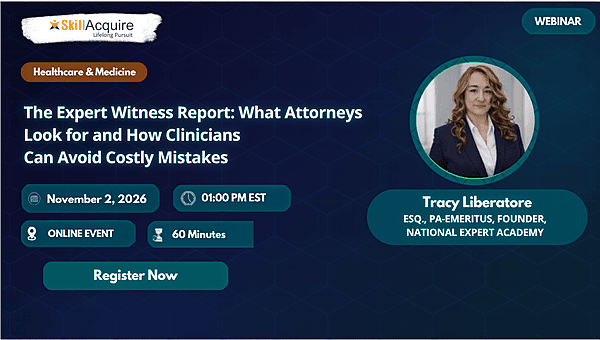
The Expert Witness Report: What Attorneys Look for and How Clinicians Can Avoid Costly Mistakes
| Presenter: Tracy Liberatore, Esq., PA-Emeritus Date: Monday, November 2, 2026 Time: 3 pm ET | 2 pm CT | 1 pm MT | 12 pm PT Duration: 60 minutes |  |
Every weak expert report has the same tell: the maybe. Hedged language, soft conclusions, opinions that leave the door open for opposing counsel. This session is about killing the maybe.
Most clinicians believe their credentials are enough to succeed as a medical expert witness. They are not. The skill attorneys evaluate first is the written expert report, and clinical training quietly works against clinicians the moment they sit down to write one. Chart notes are written to document care. Expert reports are written to explain opinions that a very smart attorney will challenge line by line. That single distinction changes everything about what to include, how to phrase it, and how to protect your own credibility.
In this 60-minute live session, Tracy Liberatore, Esq., PA-Emeritus, walks clinicians through three fundamentals of her proprietary C.L.E.A.R. Method™—the only expert report writing framework built from inside a working medical-legal firm. Attendees will learn what attorneys actually want from an expert, why an honest opinion delivered early builds the trust that leads to repeat work, and how to write conclusions within a reasonable degree of medical probability that stand on their own.
Tracy spent ten years as a physician assistant, earned her law degree, and then spent another decade founding and operating a medical-legal firm that trained and placed clinical experts for attorneys nationwide. She has lived on both sides of the table. This session gives physicians, physician assistants, nurse practitioners, and nurses a clear, professional path into expert witness work, along with the language, structure, and self-review habits that separate the experts attorneys call once from the ones they call every time.
- Explain why clinical documentation habits undermine expert report writing and what to do differently.
- Describe what attorneys want from a medical expert, including the value of delivering an honest opinion early.
- Identify the three legal concepts behind every expert report: standard of care, causation, and damages.
- Apply a four-part structure to organize a clear, professionally sound expert opinion.
- Select credibility-building opinion language and avoid phrases that signal advocacy or invite scrutiny.
- Recognize the five issues opposing counsel looks for when reviewing an expert report.
- Conduct a quick self-review to identify scope, consistency, and reasoning issues before submitting a report.
- Explain why every expert report is a permanent work product that shapes future referrals.
- The mindset shift from writing to document care to writing to explain opinions under scrutiny
- Key differences between clinical documentation and expert reports
- Common habits that weaken legal opinions
- What attorneys want from an expert, and why honest opinions lead to repeat work
- Building trust through objective analysis
- How clinical credentials function as both an asset and a liability in a legal context
- The three legal concepts behind every expert report: standard of care, causation, and damages
- How each concept supports a credible opinion that holds under cross.
- Avoiding common legal misunderstandings
- The four-part opinion framework: role and scope, applicable standard, analysis, and conclusion
- Structuring reports for clarity and credibility
- Opinion language that builds credibility, and the language that quietly destroys it
- Words and phrases that strengthen expert testimony
- Language that signals advocacy or uncertainty
- A before-and-after example of a weak opinion rewritten as a strong one
- The consistency standard, and how opinion shopping ends expert careers
- Maintaining professional integrity across cases
- The five things opposing counsel looks for in every report
- Common vulnerabilities that invite cross-examination
- Strategies to reduce avoidable challenges
- A three-question self-review to run before any report goes out
- Interactive Q&A session after the webinar and receive direct answers from our expert speaker.
- Physicians considering or beginning expert witness work
- Physician assistants exploring medical-legal consulting
- Nurse practitioners interested in expert reporting
- Registered nurses and legal nurse consultants
- Specialist physicians who review medical records for attorneys
- Clinicians already performing expert witness work without a repeatable system
- Healthcare professionals seeking a parallel income alongside clinical practice
- Independent medical examiners
- Retired or semi-retired clinicians planning their next career chapter
- Clinicians experiencing burnout who want to leverage their expertise in a new way
- Medical directors and clinical leaders
- Healthcare professionals with forensic or legal interests
- Clinicians who have been asked to serve as expert witnesses and want to do it well
- Hospital-based physicians and specialists
- Private practice physicians and healthcare providers
- Academic physicians and clinical faculty members
- Occupational and environmental medicine professionals
- Case managers and utilization review professionals
- Risk management and healthcare compliance professionals
- Healthcare professionals interested in building a long-term expert witness career
Tracy Liberatore, Esq., PA-Emeritus, Founder, National Expert Academy
Tracy is the founder of the National Expert Academy and the creator of the C.L.E.A.R. Method™, the only expert report writing framework built from inside a working medical-legal firm. Through the National Expert Academy she trains clinicians to write expert reports attorneys trust. She spent ten years as a physician assistant before earning her law degree as valedictorian. She then spent another decade founding and operating a medical-legal firm that trained and placed clinical experts for attorneys nationwide. Drawing on her clinical practice, legal training, and medical-legal firm experience, she has lived on both sides of the table and now teaches clinicians how to translate their medical expertise into clear, credible expert opinions that attorneys trust. She is the author of From Medicine to Law and the host of the Statutes & Stethoscopes podcast. Her work has been featured in USA Today and KevinMD.
You will receive an email with login information and handouts (presentation slides) that you can print and share with all participants at your location.
- Internet Speed: Preferably above 1 MBPS
- Headset: Any decent headset and microphone which can be used to talk and hear clearly
No problem. You can get access to an On-Demand webinar. Use it as a training tool at your convenience.
Toll-Free No: 1-302-444-0162
Email: care@skillacquire.com
Address: 651 N. Broad Street, Suite 206, Middletown, DE 19709