
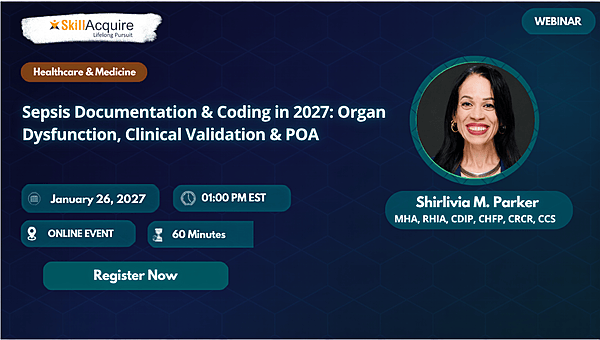
Sepsis Documentation & Coding in 2027: Organ Dysfunction, Clinical Validation & POA
Presenter: Shirlivia M. Parker, MHA, RHIA, CDIP, CHFP, CRCR, CCS Date: Tuesday, January 26, 2027 Time: 1 pm ET | 12 pm CT | 11 am MT | 10 am PT Duration: 60 minutes |  |
Course Description
Sepsis documentation, clinical validation, and coding accuracy continue to present significant challenges for physicians, Clinical Documentation Integrity (CDI) professionals, and healthcare organizations. As clinical recommendations evolve and FY 2027 ICD-10-CM coding guidelines take effect, healthcare professionals must understand how to accurately identify infection-related organ dysfunction, interpret clinical indicators, and ensure that physician documentation supports appropriate code assignment and quality reporting.
This practical, case-based webinar examines the Sepsis-3 framework, which defines sepsis as life-threatening organ dysfunction caused by a dysregulated host response to infection. Participants will explore the operational role of an acute increase in the Sequential Organ Failure Assessment (SOFA) score of at least two points and understand why lactate, bicarbonate, pH, and metabolic acidosis do not independently contribute SOFA points, despite their clinical significance.
The session will examine lactate physiology, including catecholamine-driven production, tissue perfusion, microcirculatory abnormalities, and hepatic and renal contributions to lactate metabolism and clearance. Attendees will learn to differentiate hyperlactatemia from lactic acidosis and acidemia by evaluating pH, bicarbonate, anion gap, lactate trends, and competing clinical conditions.
Key clinical and coding considerations for 2027 will include updated Surviving Sepsis Campaign recommendations on sepsis screening, biomarker limitations, serial lactate monitoring, and individualized resuscitation. The presentation will also address FY 2027 ICD-10-CM sepsis coding guidance, associated acute organ dysfunction, documentation requirements, and accurate Present on Admission (POA) reporting.
Through contrasting clinical case studies, participants will examine how laboratory findings, clinical progression, physician assessment, and competing diagnoses influence clinical validation. The discussion will address common disagreements among physicians, CDI reviewers, and coders, emphasizing neutral, nonleading, clinically supported physician queries rather than interpreting isolated laboratory abnormalities as definitive diagnoses.
Attendees will leave with a practical framework for interpreting lactate findings, evaluating infection-related organ dysfunction, strengthening clinical documentation, applying current coding guidance, and improving physician-CDI-coder collaboration. The ultimate goal is to promote clinically defensible decisions, accurate coded data, stronger documentation integrity, and more reliable hospital quality reporting.
Learning Outcomes
Explain the Sepsis-3 definition and the role of SOFA in identifying organ dysfunction. Identify the six SOFA organ systems and understand its scoring limitations. Describe lactate production, tissue perfusion, and impaired lactate clearance. Differentiate hyperlactatemia, lactic acidosis, and acidemia. Interpret lactate trends, acid-base findings, and alternative clinical causes. Apply 2026 Surviving Sepsis Campaign recommendations to clinical assessment. Evaluate clinical indicators supporting infection-related acute organ dysfunction. Apply FY 2027 ICD-10-CM sepsis coding and documentation guidelines. Develop appropriate CDI queries and clinical validation strategies. Explain accurate POA reporting and its impact on coding integrity and quality measurement.
Areas Covered in the Session
Sepsis-3: conceptual definition versus operational SOFA criteria. SOFA limitations and the distinction between a scoring tool and a comprehensive clinical assessment. The six scored organ systems and why lactate itself does not contribute SOFA points. Lactate as a metabolic signal rather than an organ-specific diagnosis. Host stress response, catecholamines, glycolysis, and lactate generation. Microcirculatory abnormalities, tissue perfusion, and oxygen delivery. Hepatic and renal contributions to lactate metabolism and clearance. Hyperlactatemia versus lactic acidosis; acidemia versus an acidifying process. Clinical assessment of pH, bicarbonate, anion gap, lactate trends, perfusion, and competing causes. Teaching case: transient lactate elevation from 2.1 to 1.4, with creatinine and MAP findings. Teaching case: lactate 4.9, pH 7.22, and bicarbonate 14—what the findings support and what they do not prove. Neutral CDI queries, physician attribution, clinical validation, and coded diagnosis integrity. POA timing and documentation: conditions present on admission, hospital-onset conditions, and quality implications. Interactive Q&A Session
Recommended Participants
Clinical Documentation Integrity (CDI) specialists CDI managers and directors Inpatient coding professionals Coding managers and directors Hospitalists Emergency medicine physicians Critical care physicians Physician advisors Clinical validation and denial specialists Revenue cycle leaders Health information management (HIM) leaders Quality and patient safety professionals Risk adjustment specialists Clinical educators and informatics professionals Compliance and utilization review professionals Inpatient coding auditors and compliance auditors Sepsis program coordinators and clinical program managers Hospital quality improvement and performance improvement specialists Physician educators and clinical documentation educators Clinical case management and utilization management directors
About the Presenter
Shirlivia M. Parker, MHA, RHIA, CDIP, CHFP, CRCR, CCS, is the Founder and CEO of Shirlivia M. Parker LLC, a boutique healthcare consulting firm. She is a healthcare leader with more than 20 years of experience spanning clinical documentation integrity, coding, health information management, quality, patient safety, and revenue cycle operations. Her work connects clinical evidence, physician engagement, documentation, and financial and quality outcomes.
She collaborates with physicians, CDI and coding teams, and executive leaders to develop practical clinical validation workflows, strengthen documentation accuracy, address denials, and improve interdisciplinary alignment. She has led educational and operational initiatives involving Sepsis-3, lactate interpretation, coding integrity, and technology-enabled physician documentation support.
A former adjunct professor of Health Information Management and Informatics, Parker continues to mentor emerging professionals through applied learning and externship opportunities. She currently serves as Co-Chair of AHIMA’s Council for Excellence in Education and is scheduled to chair the council in 2027. She is an AHIMA Approved ICD-10-CM/PCS Trainer and holds a NAHQ microcredential in Patient Safety. Her teaching emphasizes clinically defensible decisions, neutral documentation clarification, and the importance of accurate coded data.
Additional Information
After Registration:
After registering, you'll receive a confirmation email with your unique login details and access to presentation materials. All documents are downloadable and ideal for team training or reference.
System Requirements:
- Internet Speed: Preferably above 1 Mbps
- Headset: Any decent headset and microphone that can be used to talk and hear clearly
Can't Listen Live?
No problem. You can get access to an On-Demand webinar. Use it as a training tool at your convenience.
For more information, you can reach out to the contact below:
Toll-Free No: 1-302-444-0162
Email: training@skillacquire.com
Address: 651 N. Broad Street, Suite 206, Middletown, DE 19709