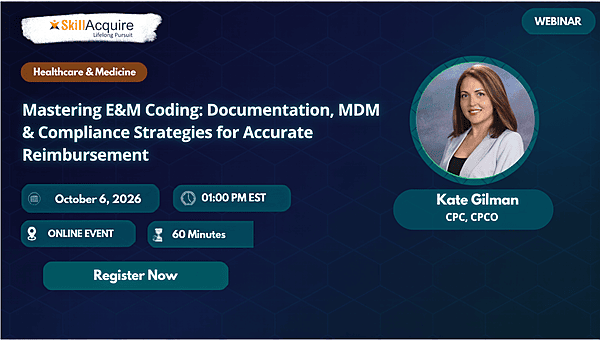
Mastering E&M Coding: Documentation, MDM & Compliance Strategies for Accurate Reimbursement
| Presenter: Kate Gilman, CPC, CPCO Date: Tuesday, October 6, 2026 Time: 1 pm ET | 12 pm CT | 11 am MT | 10 am PT Duration: 60 minutes |  |
Accurate Evaluation and Management (E&M) coding is essential for ensuring compliant documentation, appropriate reimbursement, and reduced audit risk. This webinar provides a comprehensive review of current E&M coding guidelines and documentation requirements for outpatient and office-based services. Attendees will gain a practical understanding of the latest E&M framework and learn how medical decision making (MDM), time-based coding, and documentation standards influence code selection and payment outcomes.
Through real-world examples and industry best practices, participants will explore the key elements required to support medical necessity, accurately capture provider work, and maintain compliance with regulatory expectations. The session will also highlight common documentation deficiencies, coding mistakes, and areas that frequently lead to denials, underpayments, or compliance concerns.
Designed for medical billers, coding professionals, practice managers, compliance officers, and healthcare providers, this training will provide actionable strategies to improve documentation quality, coding accuracy, and revenue cycle performance. Attendees will leave with a stronger understanding of how to properly document patient encounters, apply E&M coding guidelines with confidence, and implement processes that support audit readiness and reimbursement integrity.
Join industry expert Kate Gilman, CPC, CPCO, as she shares practical insights and proven techniques to help healthcare organizations strengthen compliance and optimize coding outcomes.
- Describe the current Evaluation and Management (E&M) coding framework and guidelines.
- Differentiate between Medical Decision Making (MDM) and time-based coding methodologies.
- Identify the key elements and levels of Medical Decision Making used in code selection.
- Apply documentation requirements that support medical necessity and coding accuracy.
- Recognize common E&M documentation deficiencies and coding errors that can lead to denials or compliance risks.
- Demonstrate proper documentation techniques for outpatient and office-based encounters.
- Select appropriate E&M codes based on documentation, MDM, and time criteria.
- Understand the impact of accurate E&M coding on reimbursement, compliance, and audit readiness.
- Evaluate clinical documentation to ensure it supports the reported level of service.
- Implement best practices to improve documentation quality and reduce coding-related risks.
- Develop strategies to strengthen compliance and optimize revenue cycle performance through accurate E&M coding.
- Overview of the Current E&M Coding Framework
- Key changes in E&M coding guidelines
- Applicability across outpatient and office-based settings
- Understanding Medical Necessity in E&M Services
- How medical necessity supports code selection
- Documentation considerations for compliance
- Medical Decision Making (MDM) Fundamentals
- The three elements of MDM
- Determining MDM levels
- Common MDM documentation pitfalls
- Time-Based E&M Coding
- Comparing MDM and Time-Based Coding
- Selecting the most appropriate methodology
- Documentation requirements for each approach
- Documentation Requirements for Accurate Code Selection
- Essential documentation elements
- Common Documentation Deficiencies and Coding Errors
- Frequent audit findings
- Causes of denials and reimbursement issues
- Strategies to avoid common mistakes
- Best Practices for Documenting Clinical Encounters
- Improving clarity and completeness of provider notes
- Case Studies and Practical Coding Examples
- Real-world E&M coding scenarios
- Applying guidelines to complex encounters
- Compliance and Audit Readiness
- Maintaining defensible documentation
- Reducing compliance risks
- Improving Documentation Quality
- Workflow enhancements for providers and staff
- Communication between clinical and billing teams
- Ongoing monitoring and education strategies
- Revenue Cycle Impact of E&M Coding
- Effects on reimbursement and accounts receivable
- Action Plan for Successful E&M Coding Implementation
- Key takeaways and implementation strategies
- Interactive Q&A Session After the Webinar and Receive Direct Answers from Our Expert Speaker
- Medical Billers
- Medical Coding Professionals
- Coding Managers
- Revenue Cycle Managers
- Revenue Cycle Directors
- Practice Managers
- Practice Administrators
- Compliance Officers
- Healthcare Compliance Managers
- Physicians
- Nurse Practitioners (NPs)
- Physician Assistants (PAs)
- Medical Directors
- Practice Owners
- Healthcare Consultants
- Clinical Documentation Improvement (CDI) Specialists
- Healthcare Auditors
- Office and Operations Managers
Kate Gilman, CPC, CPCO
has over two decades of revenue cycle management experience in the healthcare industry. She is an expert at uncovering and correcting billing and credentialing inefficiencies and errors while streamlining operations to achieve optimal results. Kate’s experience spans both small and large practices, ranging from primary care providers to specialists and surgeons. She is known for keeping accounts receivable as low as possible while ensuring collections are maximized. Kate’s acute attention to detail, deep understanding of coding and billing, and proactive approach make her an indispensable asset to her clients.
You will receive an email with login information and handouts (presentation slides) that you can print and share with all participants at your location.
- Internet Speed: Preferably above 1 MBPS
- Headset: Any decent headset and microphone which can be used to talk and hear clearly
No problem. You can get access to an On-Demand webinar. Use it as a training tool at your convenience.
Toll-Free No: 1-302-444-0162
Email: care@skillacquire.com
Address: 651 N. Broad Street, Suite 206, Middletown, DE 19709