
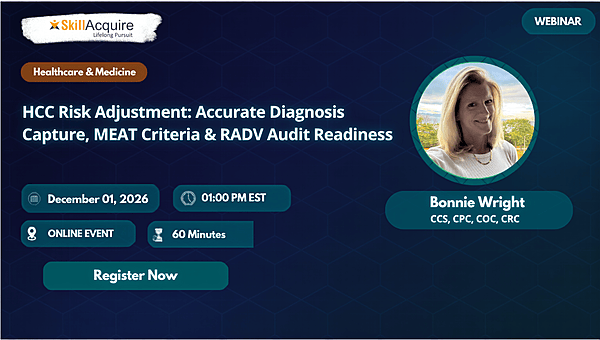
HCC Risk Adjustment: Accurate Diagnosis Capture, MEAT Criteria & RADV Audit Readiness
Presenter: Bonnie Wright, CCS, CPC, COC, CRC Date: Tuesday, December 01, 2026 Time: 1 pm ET | 12 pm CT | 11 am MT | 10 am PT Duration: 60 minutes |  |
Course Description
Accurate, compliant documentation is essential to effective risk adjustment, appropriate Hierarchical Condition Category (HCC) assignment, and defensible Medicare Advantage risk scores. However, incomplete documentation, insufficient clinical specificity, and confusion between active, historical, and resolved conditions can create coding inaccuracies and increase audit exposure. This webinar provides a practical, clinician-friendly approach to strengthening risk-adjustment documentation, improving HCC capture, and aligning clinical records with applicable Centers for Medicare & Medicaid Services (CMS) requirements.
Participants will explore the fundamentals of the CMS-HCC risk adjustment model and understand how documented diagnoses support Risk Adjustment Factor (RAF) calculations. The session will examine how to apply MEAT (Monitor, Evaluate, Assess/Address, Treat) criteria consistently, ensuring that reported chronic conditions are supported by clear, relevant documentation in the medical record. Through practical examples, attendees will learn to identify common documentation gaps, improve specificity for complex conditions, and distinguish current diagnoses from historical conditions and residual effects of previously resolved illnesses.
The webinar will also address documentation considerations for high-impact chronic conditions, including diabetes with complications, chronic kidney disease, congestive heart failure, and COPD. Participants will discover practical strategies for improving communication and collaboration among providers, coders, and clinical documentation improvement teams to reduce inconsistencies and promote shared accountability for compliant risk adjustment.
Real-world case scenarios, sample documentation reviews, and before-and-after examples will demonstrate how stronger documentation practices can support accurate coding and audit preparedness. The session will also highlight common Risk Adjustment Data Validation (RADV) audit concerns and practical measures organizations can implement to strengthen their documentation processes.
Whether your organization is working to improve RAF accuracy, address under-coding, prepare for audits, or establish more consistent documentation workflows, this webinar will provide actionable strategies to support defensible HCC capture, strengthen compliance, and improve the quality and reliability of risk-adjustment documentation.
Learning Objectives
Ensure that documentation fully supports reported diagnoses and compliant HCC capture. Strengthen audit readiness through defensible, standards-aligned documentation. Improve collaboration among providers, coders, and documentation teams. Apply MEAT criteria consistently across chronic and complex conditions. Identify and correct documentation gaps that affect risk scores. Enhance documentation specificity for high-impact chronic and complex conditions to support accurate HCC assignment and reduce the risk of undercoding or misclassification. Clearly differentiate active, historical, and resolved conditions in documentation to prevent compliance issues and support accurate risk scoring.
Areas Covered in the Session
- Overview of CMS-HCC model and how diagnoses translate into risk scores
- How RAF scores influence reimbursement and quality outcomes
- The role of provider documentation in supporting accurate risk capture
- Deep dive into Monitor, Evaluate, Assess/Address, Treat and how each element must appear in documentation
- Examples of compliant vs non-compliant documentation
- Common MEAT failures that lead to RADV audit findings
- Diabetes (with complications)
- Chronic kidney disease
- Congestive heart failure
- COPD and asthma
- How specificity affects HCC assignment and prevents under coding or misclassification
- How to correctly document active vs historical diagnoses
- When and how to document residual effects of past conditions
- Avoiding common pitfalls such as coding history-only conditions as active
- Impact of incorrect status documentation on compliance and audit exposure
- Best practices for ensuring documentation reflects the current clinical picture
- Strategies for improving provider awareness and reducing documentation errors
- How provider workflows influence coding accuracy and audit readiness
- Guided examples showing compliant documentation for complex patients
- Before and after documentation comparisons
- Review of sample notes to reinforce specificity and MEAT
- How documentation supports RADV audit defense
- Frequent audit triggers and how to avoid them
- Building documentation habits that reduce compliance risk
Interactive Q&A session with Bonnie Wright, CCS, CPC, COC, CRC
Suggested Attendees
- Medical Billers
- Medical Coders
- Physicians and Healthcare Providers
- Practice Managers
- Healthcare Auditors
- Healthcare Administrators
- Revenue Cycle Management Team Members
- Healthcare Compliance Officers
- Risk Adjustment Specialists
- HCC Coding Specialists
- Clinical Documentation Improvement (CDI) Specialists
- Risk Adjustment Auditors
- Health Information Management (HIM) Professionals
- Medical Billing and Coding Managers
- Risk Adjustment Managers and Directors
- Clinical Documentation Integrity Managers
- Medicare Advantage Program Managers
- Healthcare Quality Assurance Professionals
- Provider Education and Training Specialists
- Medical Directors
About the Presenter
Additional Information
After Registration:
After registering, you'll receive a confirmation email with your unique login details and access to presentation materials. All documents are downloadable and ideal for team training or reference.
System Requirements:
- Internet Speed: Preferably above 1 Mbps
- Headset: Any decent headset and microphone that can be used to talk and hear clearly
Can't Listen Live?
No problem. You can get access to an On-Demand webinar. Use it as a training tool at your convenience.
Toll-Free No: 1-302-444-0162
Email: training@skillacquire.com
Address: 651 N. Broad Street, Suite 206, Middletown, DE 19709