
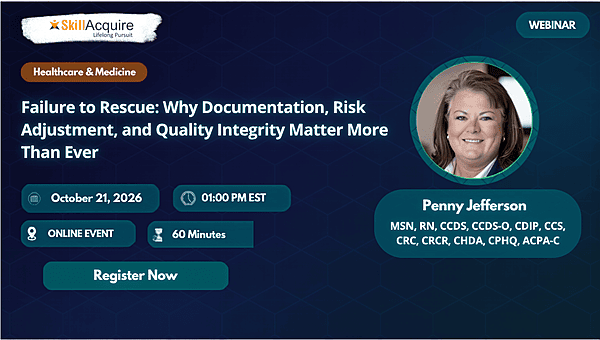
Failure to Rescue: Why Documentation, Risk Adjustment, and Quality Integrity Matter More Than Ever
| Presenter: Penny Jefferson, MSN, RN, CCDS, CCDS-O, CDIP, CCS, CRC, CHDA, CRCR, CPHQ, ACPA-C Date: Wednesday, October 21, 2026 Time: 1:00 pm ET | 12:00 pm CT | 11:00 am MT | 10:00 am PT Duration: 60 minutes |  |
Program Synopsis
CMS is transforming how hospitals are evaluated by replacing the traditional Patient Safety Indicator (PSI) Failure-to-Rescue measure with a new 30-day Risk-Standardized Failure-to-Rescue outcome measure. This change shifts the focus beyond identifying complications to evaluating whether hospitals successfully recognize, escalate, and manage those complications while accurately representing patient complexity through documentation and risk adjustment.
Many organizations are unaware that documentation integrity now plays a significant role in these outcomes. Failure-to-Rescue is no longer solely a quality metric—it has become a multidisciplinary responsibility involving CDI, coding, physician advisors, quality, case management, utilization review, and physician documentation.
This webinar will explain the new CMS methodology, how expected mortality is calculated using Elixhauser comorbidities and other risk-adjustment variables, and why incomplete documentation can artificially worsen hospital performance. Participants will learn how documentation affects observed versus expected mortality, how surgical complications are evaluated, and how organizations can proactively prepare for this evolving quality measure.
Rather than viewing Failure-to-Rescue as simply a mortality metric, attendees will understand it as a measure of documentation integrity, clinical escalation, patient complexity, and overall organizational performance.
Course Description
CMS is changing how hospitals are measured—and documentation has never mattered more.
Failure-to-Rescue is evolving from a traditional patient safety indicator into a sophisticated, risk-standardized quality outcome that evaluates a hospital's ability to recognize, manage, and successfully treat serious complications. But behind every quality score is the medical record.
Join nationally recognized CDI leader Penny Jefferson as she explains the new CMS methodology, the growing importance of risk adjustment and Elixhauser comorbidities, and why documentation integrity has become a critical driver of quality performance. Learn how CDI, coding, physician advisors, quality professionals, and providers can work together to ensure patient complexity is accurately represented while improving organizational performance in an increasingly transparent healthcare environment.
Learning Outcomes
- Describe CMS's new Failure-to-Rescue quality measure and how it differs from the traditional PSI-04 methodology.
- Explain how risk adjustment and Elixhauser comorbidities influence expected mortality and hospital performance.
- Identify documentation opportunities that improve the accuracy of severity of illness (SOI), risk of mortality (ROM), and quality reporting.
- Recognize the roles of CDI, coding, physician advisors, quality, utilization review, case management, and providers in improving Failure-to-Rescue outcomes.
- Explain how observed versus expected mortality is calculated and why accurate documentation directly impacts quality scores.
- Identify common documentation gaps that can negatively affect risk adjustment, quality reporting, and hospital performance.
- Discuss how timely clinical recognition, escalation, and documentation of complications contribute to improved Failure-to-Rescue outcomes.
- Evaluate the impact of physician documentation on accurately capturing patient complexity and clinical severity.
- Describe multidisciplinary collaboration strategies that strengthen documentation integrity and support accurate quality measurement.
- Develop organizational strategies to improve documentation integrity while maintaining regulatory compliance and defensible medical records.
Areas Covered in the Session
- The evolution of CMS Failure-to-Rescue measurement
- Why CMS replaced the traditional PSI measure
- Understanding 30-day Risk-Standardized Failure-to-Rescue
- How observed versus expected mortality is calculated
- The importance of Elixhauser comorbidities
- Documentation's impact on risk adjustment
- Capturing patient complexity accurately
- Clinical validation versus documentation opportunities
- Surgical complications and escalation of care
- Interdisciplinary collaboration across CDI, Coding, Quality, UR, Case Management, and Physician Advisors
- Common documentation gaps that influence quality metrics
- Executive dashboards and operational monitoring
- Preparing organizations for future CMS quality reporting
- Interactive Q&A Session with Penny Jefferson – Get your questions answered live by the expert after the webinar.
Recommended Participants
- Clinical Documentation Integrity (CDI) Specialists
- Medical Coding Professionals
- Health Information Management (HIM) Professionals
- Physician Advisors
- Quality Improvement Professionals
- Quality Directors and Managers
- Utilization Review Professionals
- Case Management Professionals
- Revenue Integrity Professionals
- Clinical Documentation Managers
- Coding Managers and Directors
- Health Information Management Leaders
- Quality Executives
- Chief Medical Officers (CMOs)
- Chief Nursing Officers (CNOs)
- Chief Quality Officers (CQOs)
- Hospital Administrators and Healthcare Executives
- Physicians
- Advanced Practice Providers (NPs and PAs)
- Compliance and Regulatory Affairs Professionals
Key Takeaways
Participants will leave with a practical understanding of how CMS's new Failure-to-Rescue methodology evaluates hospitals, why complete and clinically supported documentation is essential for accurate risk adjustment, and how multidisciplinary collaboration can improve both quality outcomes and public reporting. Attendees will gain actionable strategies to ensure the medical record accurately reflects patient complexity while supporting defensible, compliant documentation.
About the Presenter
Penny Jefferson, MSN, RN, CCDS, CCDS-O, CDIP, CCS, CRC, CRCR, CHDA, CPHQ, ACPA-C is the Director of Clinical Documentation Integrity at UC Davis Health, where she leads enterprise-wide initiatives focused on improving documentation accuracy, medical necessity support, and revenue integrity. She brings extensive experience in CDI, revenue cycle operations, and regulatory compliance, with a focus on aligning documentation practices to meet evolving payer and regulatory expectations.
Penny is a national speaker and educator, serving as a co-host of Talk Ten Tuesday and a recognized thought leader in the CDI and physician advisor space. She is actively involved in the American College of Physician Advisors (ACPA), where she co-chairs the CDI Committee and leads the CommUnity Denials and Appeals focus group, bringing together interdisciplinary leaders to address emerging challenges in documentation and audit defense.
She is known for translating complex regulatory and operational concepts into practical, actionable strategies that support healthcare teams in improving documentation integrity, reducing denials, and strengthening overall revenue performance.
Additional Information
You will receive an email with login information and handouts (presentation slides) that you can print and share with all participants at your location.
- Internet Speed: Preferably above 1 Mbps
- Headset: Any decent headset and microphone which can be used to talk and hear clearly
No problem. You can get access to an On-Demand webinar. Use it as a training tool at your convenience.
Toll-Free No: 1-302-444-0162
Email:care@skillacquire.com
Address: 651 N. Broad Street, Suite 206, Middletown, DE 19709