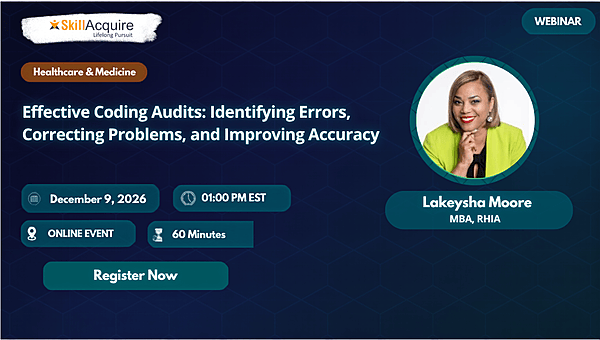
Effective Coding Audits: Identifying Errors, Correcting Problems, and Improving Accuracy
Presenter: Lakeysha Moore, MBA, RHIA Date: Wednesday, December 9, 2026 Time: 1 pm ET | 12 pm CT | 11 am MT | 10 am PT Duration: 60 minutes |  |
Course Description
Medicare made an estimated $28.83 billion in improper fee-for-service payments in FY 2025, with insufficient documentation identified as the leading cause. For healthcare organizations, coding audits are essential—but identifying errors is only the beginning. When findings lead to generic education instead of targeted corrective action, the same mistakes can reappear, increasing compliance exposure, payment risk, and the likelihood of repeat audit findings.
How can your organization turn audit results into measurable, lasting improvement?
This practical webinar equips coding, Health Information Management (HIM), Clinical Documentation Integrity (CDI), revenue cycle, and compliance professionals with a repeatable approach to transforming audit findings into meaningful results across inpatient, outpatient, and professional billing.
Learn how to design focused audits, select appropriate probe or statistically valid samples, measure code-level and payment-level accuracy, and identify the root causes behind recurring errors. Explore high-risk audit targets, including MS-DRG validation, CC/MCC capture, principal diagnosis selection, outpatient modifiers, NCCI edits, and E/M level selection.
Through real-world case studies, you’ll discover how to distinguish knowledge gaps from documentation, workflow, and technology issues; prioritize findings by financial impact and compliance risk; and build corrective action plans with clear owners, deadlines, targeted education, and measurable success criteria.
The session also examines how to move beyond punitive auditing toward a learning-focused culture grounded in Just Culture principles and appropriate accountability. Understand the importance of the 60-day overpayment reporting and return obligation, when to involve compliance, and how focused re-audits, repeat-error tracking, and leadership dashboards can demonstrate whether corrective actions are working.
Leave with a practical 90-day action plan to strengthen your audit program, reduce recurring coding and documentation errors, support compliant reimbursement, and turn audit findings into sustainable organizational improvement.
Learning Objectives
- Differentiate audit types and sampling methods across inpatient, outpatient and professional claims.
- Identify high-risk coding and documentation errors in each care setting.
- Calculate coding accuracy, payment accuracy and financial impact from audit findings.
- Apply root cause analysis to identify why errors occur and recur.
- Prioritize audit findings based on financial impact and compliance risk.
- Develop corrective action plans with clear responsibilities, deadlines and measurable outcomes.
- Design targeted, case-based education to prevent recurring coding and documentation errors.
- Apply Just Culture principles to promote accountability and continuous improvement.
- Explain the 60-day overpayment reporting and return requirements and recognize when to involve compliance.
- Measure sustained improvement through re-audits, repeat-error rates and leadership dashboards.
Areas Covered in the Session
- The Cost of Improper Payments
- FY 2025 CERT results
- What drives coding errors
- FY 2025 CERT results
- The Audit-to-Improvement Cycle
- Plan and review
- Validate
- Find the root cause
- Correct
- Re-audit
- Plan and review
- Audit Types
- Prospective vs. retrospective
- Focused vs. random
- Internal vs. external
- Prospective vs. retrospective
- Sampling Methods
- Probe samples vs. statistically valid samples
- When to extrapolate
- Probe samples vs. statistically valid samples
- Accuracy Metrics
- Code accuracy
- Payment-group accuracy
- Financial impact
- Code accuracy
- Inpatient Audit Targets
- MS-DRG validation
- Principal diagnosis
- CC/MCC capture
- POA indicators
- Sepsis and high-risk DRGs
- MS-DRG validation
- Outpatient Audit Targets
- APCs
- Modifiers 25, 59 and X{EPSU}
- NCCI edits
- MUEs
- Units and chargemaster errors
- APCs
- Professional Billing Audits
- E/M level selection by medical decision making or time
- Incident-to and split/shared visits
- Provider outlier analysis
- E/M level selection by medical decision making or time
- Case Studies Across Care Settings
- Examples showing how audit findings become actionable fixes
- Examples showing how audit findings become actionable fixes
- Root Cause Classification
- Coder knowledge
- Documentation
- Process and technology
- Coder knowledge
- Prioritizing Audit Findings
- Financial impact and compliance risk
- Effort required to implement corrective actions
- Financial impact and compliance risk
- Corrective Action Plans and Targeted Education
- Assigning owners, due dates and success measures
- Targeted education that changes practice
- Assigning owners, due dates and success measures
- Building a Learning-Focused Audit Culture
- Moving from punitive audits to Just Culture accountability
- The 60-day overpayment rule
- Re-audits and leadership dashboards
- Moving from punitive audits to Just Culture accountability
- Interactive Live Q&A Session with Lakeysha Moore
Suggested Attendees
- Inpatient Coders
- Outpatient Coders
- Professional Fee / Physician Coders
- Coding Auditors and Validators
- Coding Managers and Supervisors
- Coding Educators and Trainers
- Clinical Documentation Integrity (CDI) Specialists
- HIM Directors and Managers
- Compliance Officers and Compliance Auditors
- Revenue Integrity Analysts
- Revenue Cycle Directors and Managers
- Medical Billers and Billing Managers
- Chargemaster (CDM) Analysts
- Physician Practice Managers
- Physicians, Advanced Practice Providers and Physician Advisors
- Coding Quality Assurance Specialists
- Healthcare Internal Auditors
- Denial Prevention and Appeals Specialists
- Payer Audit and Audit Response Specialists
- Healthcare Regulatory and Legal Professionals
About the Presenter
Lakeyshia M. Moore, MBA, RHIA, is a health information management executive with more than 24 years of leadership experience in HIM operations, medical coding, and clinical documentation integrity. She is the Director of Coding Operations at Parkland Health, a Level I trauma center in Dallas, where she leads more than 130 staff across hospital and professional billing coding operations, including coding quality reviews, denial management, and staff education.
Before joining Parkland, Lakeyshia led coding, denials, and reimbursement for 17 wholly owned and five joint venture hospitals at Texas Health Resources. She centralized coding for 14 hospitals into a single team and led the system through the ICD-10 transition. She also established a coding compliance auditing program and a pre-bill review process for PSI-90 (AHRQ's patient safety indicator measure). Earlier in her career, she served as HIM Director and Privacy Officer at West Jefferson Medical Center, where she managed RAC audits and DRG appeals and rebuilt the CDI program. She has also implemented Epic, Cerner, and computer-assisted coding systems at several organizations.
Lakeyshia served as President of the Texas Health Information Management Association (TXHIMA) in 2025 and as President of the Dallas-Fort Worth HIM Association (DFWHIMA). She has been a member of the AHIMA House of Delegates since 2022 and serves on AHIMA's Revenue Cycle Community of Practice committee. She has published articles in For The Record, the ACDIS CDI Journal, and HFMA publications, and has presented at the Optum Forum, TXHIMA, and DFWHIMA. She holds an MBA from Sullivan University and a BS in Health Information Management from Eastern Kentucky University.
Additional Information
After Registration:
After registering, you'll receive a confirmation email with your unique login details and access to presentation materials. All documents are downloadable and ideal for team training or reference.
System Requirements:
- Internet Speed: Preferably above 1 Mbps
- Headset: Any decent headset and microphone that can be used to talk and hear clearly
Can't Listen Live?
No problem. You can get access to an On-Demand webinar. Use it as a training tool at your convenience.
Toll-Free No: 1-302-444-0162
Email: training@skillacquire.com
Address: 651 N. Broad Street, Suite 206, Middletown, DE 19709